Skip to main content

It’s not easy running a business right now. Between rising costs, technology growing faster than budgets, and the ongoing tug-of-war between in-office and remote work, many small business owners in Texas are feeling stretched thin. While the goals of profitability, growth, and stability remain the same, the path to reach them has become less predictable.
At Strategic Technology Partners of Texas (STPT), we work daily with local businesses such as independent medical practices and school districts, as well as marketing agencies and construction firms. While every organization is unique, we’ve noticed five recurring challenges that nearly every Texas SMB is trying to overcome, and more importantly, the smart ways they’re tackling them.
In this article, we’ll explore those five business challenges and how small and mid-sized businesses are solving them in practical, sustainable ways. Many of these problems are tied directly to how they manage technology, documents, and daily operations.
Table of Contents
- Rising Operational Costs
- Hybrid Work and Workflow Disorganization
- Cybersecurity and Data Protection
- Labor Shortages and Burnout
- Sustainability and Efficiency Expectations
- Turning Challenges into Opportunities for Growth
1. Rising Operational Costs
The cost of doing business is rising, and small businesses are feeling it the most.
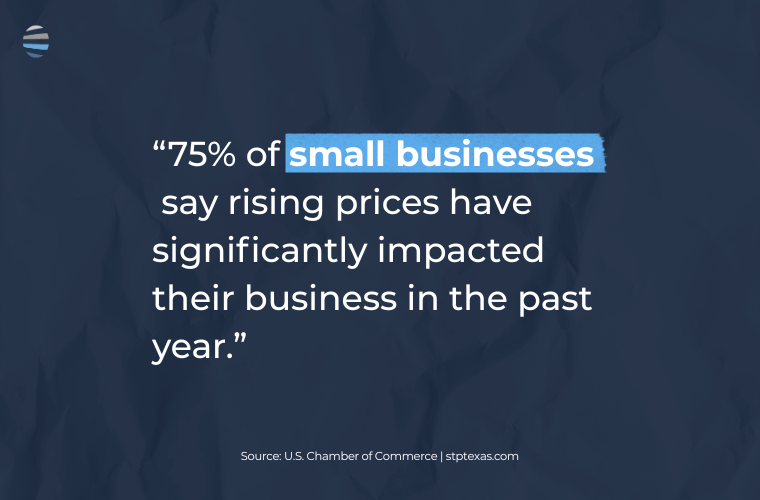
From energy and supplies to technology subscriptions, everything has become more expensive. According to the U.S. Chamber of Commerce, nearly 75% of small business owners say inflation has had a significant impact on their operations in the past year.
In Texas, where many businesses rely on multiple vendors for equipment and software, these expenses can quietly multiply. Local SMBs are responding by streamlining their vendor relationships and auditing expenses to focus on what truly drives productivity.
For example, some organizations are consolidating their print, scan, and document workflows under a single managed service provider rather than juggling several. This is a step towards gaining clarity. By simplifying their technology stack, they can finally see where money is being wasted and where efficiency can grow.
2. Hybrid Work and Workflow Disorganization
The hybrid model is here to stay, but for many SMBs who are not ready, it’s introduced chaos. Files live everywhere, such as on laptops, cloud folders, desktops, and in stacks of paper waiting to be scanned. This can cause collaboration to slow down, version control to break, and documents to vanish into digital clutter.
But businesses are learning that the solution isn’t just to adopt the cloud, but rather to maintain organization and consistency. To accomplish this, many are introducing document management systems that standardize where digital files live, how they’re named, and how they’re shared.
Others are making their print environments hybrid-friendly with tools that let employees print securely from any location or route scanned files directly into shared folders or cloud apps.
If you’re reevaluating how your team works between office and home, you might find our blog on Where Does Printing Fit in a Hybrid Workspace? helpful. It breaks down how physical and digital tools can coexist productively in a modern office.
3. Cybersecurity and Data Protection
For small businesses, cybersecurity may seem like an enterprise problem, but it’s most definitely not.
SMBs are being targeted almost four times more frequently than large corporations, according to the recent Verizon Data Breach Investigations Report.
Unfortunately, many local companies underestimate how exposed their networks (and printers) really are.
Printers and multifunction devices are now connected endpoints and can be exploited if left unsecured. Local SMBs are getting smarter about this by:
- Regularly updating firmware and patches
- Enabling secure print release features
- Training employees to recognize phishing and security risks
- Investing in network monitoring tools or local IT support
Small businesses don’t have the security budget a large enterprise would have, so being strategic about cybersecurity is critical.
If you haven’t already, check out 5 Steps to Make Your Office Cybersecure or Have You Heard of Cybersecurity Insurance? Both explain how even small measures can dramatically reduce your risk.
4. Labor Shortages and Burnout

Hiring and retaining employees continues to challenge small businesses. In Texas, there are several job openings, but the competition for skilled talent is fierce. According to the U.S Chamber of Commerce, “14% of small business owners cited talent acquisition as a top concern.”
And while the unemployment rate, according to the Texas Workforce Commission, is 4.1%, this also means hiring replacements is both slow and costly.
In response, SMBs are focusing on making better use of the teams they already have. They’re automating repetitive, manual processes like scanning, filing, and report generation so employees can focus on higher-value work. They’re also leaning into workflow automation through tools like Xerox Capture & Content or DocuShare, which cut down on repetitive tasks and help prevent burnout.
Sometimes, improving your team's efficiency isn't about bringing in new people, but about making their daily tasks easier.
5. Sustainability and Efficiency Expectations
In today’s era, customers have come to expect some kind of sustainability effort. According to PwC’s Voice of the Consumer Survey, 46% of consumers say they are “buying more sustainable products as a way to reduce their personal impact on the environment.”
Texas businesses are adapting by finding small, practical ways to reduce waste and energy consumption. From adopting duplex printing defaults to enrolling in toner recycling programs and using energy-efficient devices, local SMBs are showing that sustainability can coexist with profitability.
Modern office printers can track energy use, automate supply shipments, and optimize print output to help cut costs. By treating sustainability as an efficiency strategy, businesses can do the right thing and save money.
Check out our blog on 5 Steps to Sustainable Printing for tips to cut printing waste.
Turning Challenges into Opportunities for Growth
The business climate in 2026 will continue to test small businesses. Texas SMBs must remain resilient and resourceful. The companies that are thriving right now aren’t necessarily the biggest, but they’re the ones finding smarter ways to work, manage technology, and stay adaptable.
In this article, we went over a few operational changes, including improving workflows, strengthening cybersecurity, and modernizing office equipment. While small, these shifts can often lead to major long-term impact.
If you’re exploring ways to make your technology and document processes more efficient, our blog Where Does Printing Fit in a Hybrid Workspace? is a great next step. It explores how local businesses are aligning people, print, and digital workflows to stay agile in a changing economy.