 Skip to main content


Most organizations don’t wake up one morning and decide they need an Enterprise Management System. What usually happens instead is that files live in one platform, approvals happen in another, and teams waste time trying to piece everything together.
In fact, research from IDC has shown that knowledge workers can spend nearly 16% of their time searching for information. That’s a full day each week lost to digital scavenger hunts.
At Strategic Technology Partners of Texas (STPT), we’ve seen businesses struggle because their tools don’t work together.
That’s why understanding the definition of an Enterprise Management System (EMS) is important.
In this guide, we’ll explain what an EMS is, how it differs from Content Management Systems (CMS) and Document Management Systems (DMS) platforms, what problems it solves, and how to know whether your organization is ready for one.
Table of Contents
- What Is an Enterprise Management System (EMS)?
- Why EMS Matters Now
- EMS vs. CMS vs. DMS
- What Problems Does an EMS Solve?
- Core Capabilities of an EMS
- How EMS Fits Into Digital Transformation
- Is Xerox DocuShare Part of an EMS Strategy?
- Who Typically Needs an EMS
- When an EMS May Be Overkill
- Key Takeaways
- EMS: Frequently Asked Questions
What Is an Enterprise Management System (EMS)?
An Enterprise Management System (EMS), often referred to as Enterprise Content Management (ECM), is a platform that helps organizations manage documents, content, records, and workflows in one connected environment. These systems unify tools like CMS and DMS so information moves securely and efficiently across the business.
An EMS acts as the orchestrator of your information ecosystem. Instead of separate systems handling content, documents, and approvals, an EMS connects them into a structured, governed framework.
In summary:
- An EMS connects content and document systems.
- An EMS centralizes business information.
- An EMS supports workflow automation across departments.
Beyond just storage, the ultimate goal of an EMS is visibility, control, and efficiency at scale.
EMS vs. ECM: Are They the Same Thing?
EMS and ECM are similar terms. ECM (Enterprise Content Management) is the more widely recognized industry term for platforms that manage documents, content, and workflows across an organization. EMS is sometimes used more broadly to describe enterprise-level management systems that unify multiple information tools.
Historically, ECM platforms were designed to manage the full lifecycle of business content and records, with a strong emphasis on document control, retention, and compliance. The term EMS is sometimes used more broadly to describe enterprise-level systems that bring together multiple information tools, including content management, document management, and workflow automation.
Today, many software vendors and analysts still prefer the ECM label, which is why you’ll often see the terms used interchangeably in the market.
Why EMS Matters Now
Organizations today face a kind of growth problem often referred to as tool sprawl.
As businesses adopt cloud apps, collaboration tools, scanners, and workflow platforms, information gets fragmented. So, while teams move faster, the governance often falls behind.
An EMS matters now because it helps organizations:
- Reduce information silos
- Improve workflow visibility
- Support hybrid work environments
- Strengthen compliance posture
- Prepare for broader digital transformation
In short, it brings structure to digital complexity.
EMS vs. CMS vs. DMS
These terms are often used interchangeably, but they serve different roles in the information management stack.
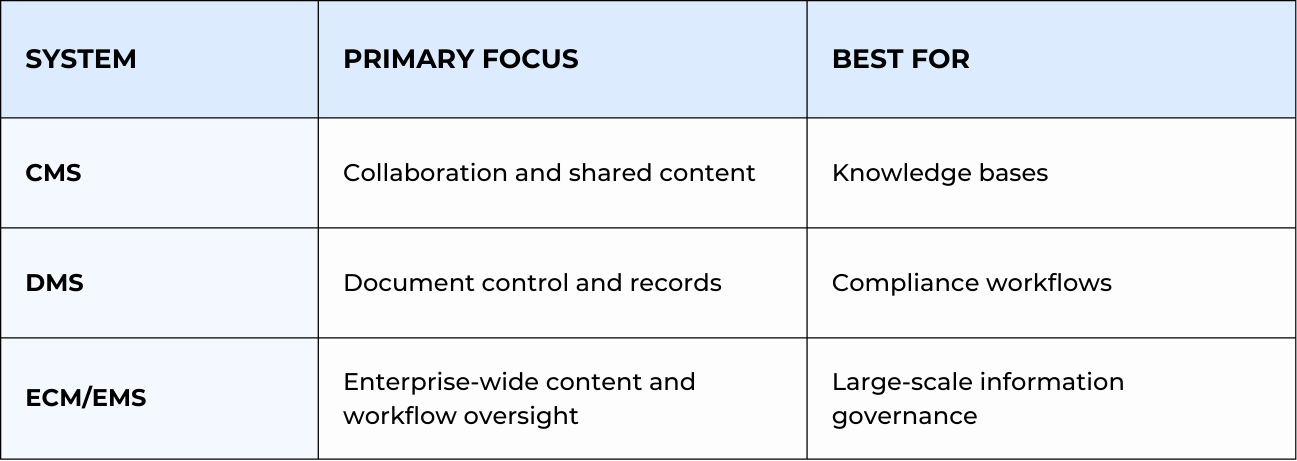
Here are some simple way to think about it:
- CMS helps teams create and share content
- DMS helps organizations control and secure documents
- EMS helps enterprises coordinate everything together
Related reading: What Is a Content Management System?
Related reading: What Is a Document Management System (DMS)?
What Problems Does an EMS Solve?
Most businesses usually start searching for an EMS once they feel friction.
Common signs your organization may need an EMS:
- Systems don’t integrate well
- Documents live in multiple silos
- Approval workflows are manual
- Compliance risk is increasing
- Employees struggle to find the right version
- Reporting across systems is difficult
An EMS addresses these issues by creating a connected information environment rather than a collection of isolated tools.
Core Capabilities of an EMS
While platforms vary, most enterprise management systems include a common set of capabilities.
Key EMS capabilities include:
- Content management
- Document management
- Workflow automation
- Records and retention management
- Role-based security and permissions
- Integration with business systems
- Search and metadata indexing
Together, these capabilities help organizations move from reactive document handling to proactive information governance.
How EMS Fits Into Digital Transformation
For many organizations, an EMS represents a maturity step in their digital journey.
Early-stage businesses often start with:
- shared drives
- basic cloud storage
- or standalone CMS tools
As complexity grows, leaders begin looking for ways to unify workflows and improve visibility across the organization.
An EMS can help enable digital transformation.
Is Xerox DocuShare Part of an EMS Strategy?
This is a smart question, and the answer depends on how the platform is deployed.
Xerox DocuShare is most commonly implemented as a document management solution. However, in many environments, it also plays an important role within a broader enterprise content strategy.
Organizations often use DocuShare to support:
- Secure document storage
- Workflow automation
- Role-based access
- Records management
- Integration with Xerox multifunction printers
For a deeper dive, see our full guide: What Is Xerox DocuShare?
When combined with capture tools, collaboration platforms, and workflow automation, DocuShare can serve as a key component within an EMS-oriented architecture.
The right fit depends on your environment, compliance needs, and long-term goals.
Who is fit for an EMS
An EMS is usually a strong fit for organizations that have moved beyond basic file sharing and are managing information at scale.
An EMS is often valuable for:
- Multi-department organizations
- Regulated industries (healthcare, finance, education, legal)
- Document-heavy environments
- Growing mid-sized businesses
- Organizations pursuing digital transformation initiatives
The larger and more complex your information environment becomes, the more valuable unified oversight tends to be.
When an EMS May Be Overkill
Not every organization needs an enterprise-level solution.
An EMS may be more than you need if your business:
- Has a small team
- Manages relatively few documents
- Has minimal compliance requirements
- Primarily needs simple file sharing
- Doesn’t require formal workflows
In these cases, a CMS or DMS alone may be the more practical starting point.
Key Takeaways
- An EMS unifies CMS and DMS capabilities into one ecosystem.
- EMS platforms improve visibility across content and document workflows.
- Organizations typically adopt EMS as complexity and compliance needs grow.
- Tools like Xerox DocuShare can play a role within a broader EMS strategy.
- Not every business needs an EMS — fit depends on scale and risk.
EMS: Frequently Asked Questions
What is the difference between EMS and ECM?
EMS and ECM are often used interchangeably. ECM is the more established industry term for managing enterprise content, documents, and workflows, while EMS is sometimes used more broadly to describe unified enterprise management platforms.
Is an EMS the same as a DMS?
No. A DMS focuses specifically on document control and records management, while an EMS provides broader oversight across multiple information systems.
Do small businesses need an EMS?
Most small businesses start with a CMS or DMS. EMS platforms typically become valuable as complexity, compliance, and cross-department workflows increase.
How does EMS support digital transformation?
An EMS supports digital transformation by connecting information systems, automating workflows, and improving visibility across the organization.
Which System Is Right for Your Business?
If your team is starting to feel the strain of disconnected systems, manual workflows, or growing compliance pressure, it may be time to take a closer look at your information environment.
At STPT, we help organizations evaluate where they are today and what level of structure makes sense. We can help guide you in deciding whether a CMS, a DMS, or a broader enterprise strategy is the right choice.
Not sure where you stand?
Talk with an STPT workflow specialist for a practical, no-pressure assessment of your current document environment.
