 Skip to main content


With the Xerox acquisition of Lexmark now moving from headline news into real-world portfolio changes, buyers are starting to see a unified print ecosystem that is reshaping how A3 and A4 fleets are bought, supported, and standardized.
This is a pivotal moment for Xerox as the office print market remains competitive. According to 360 Research Reports, in 2025 there were more than 143 million MFP shipments worldwide, largely driven by orders for A3/A4 machines.
From our experience in helping Texas businesses choose, support, and optimize printer fleets, this is one of the biggest platform shifts we’ve seen in the A3 space for Xerox.
In this article, we’ll break down what’s changing, what buyers should watch closely, and where we believe this portfolio is headed next.
Table of Contents
- What Changed After Xerox acquired Lexmark?
- Why the Lexmark 9-Series Matters to Xerox’s A3 strategy
- How the Dual-Brand Portfolio Affects Buyers
- Where Lexmark and Xerox workflows now overlap
- Our vendor perspective after 40 years in print
- Should businesses buy now or wait?
- FAQ
- Final thoughts: what buyers should do next
What Changed After Xerox Acquired Lexmark?
The biggest changes we’ve seen with the Xerox-Lemark integration are:
- Product availability
- Sales channels
- Workflow compatibility
- Fleet standardization
- Service opportunities
- Long-term branding direction
Lexmark devices are still sold under the Lexmark name today, but the strategy is clearly moving toward a more unified Xerox-aligned portfolio over the next 12–18 months.
The clearest example is the Lexmark 9-Series A3 platform, which now extends Xerox’s A3 lineup alongside established devices like the Xerox AltaLink C8200 Series. Plus, the CX833 model from the Lexmark 8-Series adds another A4 color machine to Xerox’s portfolio.
This matters because the Lexmark 9-Series expands Xerox’s A3 platform into media-heavy, service-friendly environments, while Xerox continues strengthening workflow and fleet-level consistency.
That operational overlap is what buyers should pay the closest attention to.
Why the Lexmark 9-Series Matters to Xerox’s A3 Strategy
The Lexmark 9-Series helps fill in meaningful gaps in Xerox’s broader A3 strategy.
The platform supports:
- Media sizes from A6 to SRA3
- Advanced finishing
- Long-life components
- Simplified service points
- Strong sustainability metrics
- Professional color tools like PANTONE® calibration
- Secure-by-design engineering
With this new series, Lexmark now strengthens Xerox’s ability to address more specialized A3 environments without forcing every organization into a single hardware family.
This flexibility is useful for:
- Healthcare
- Education
- Retail back-office
- Light production environments
- Manufacturing documentation workflows
Check out our reviews for the Lexmark 9-Series models:
How the Dual-Brand Portfolio Affects Buyers
If you’re a buyer considering the Lexmark 9-Series or Xerox’s current A3 offerings, it’s important to know how they compare in fit, compatibility, and long-term standardization.
Here’s how we currently see the portfolio.
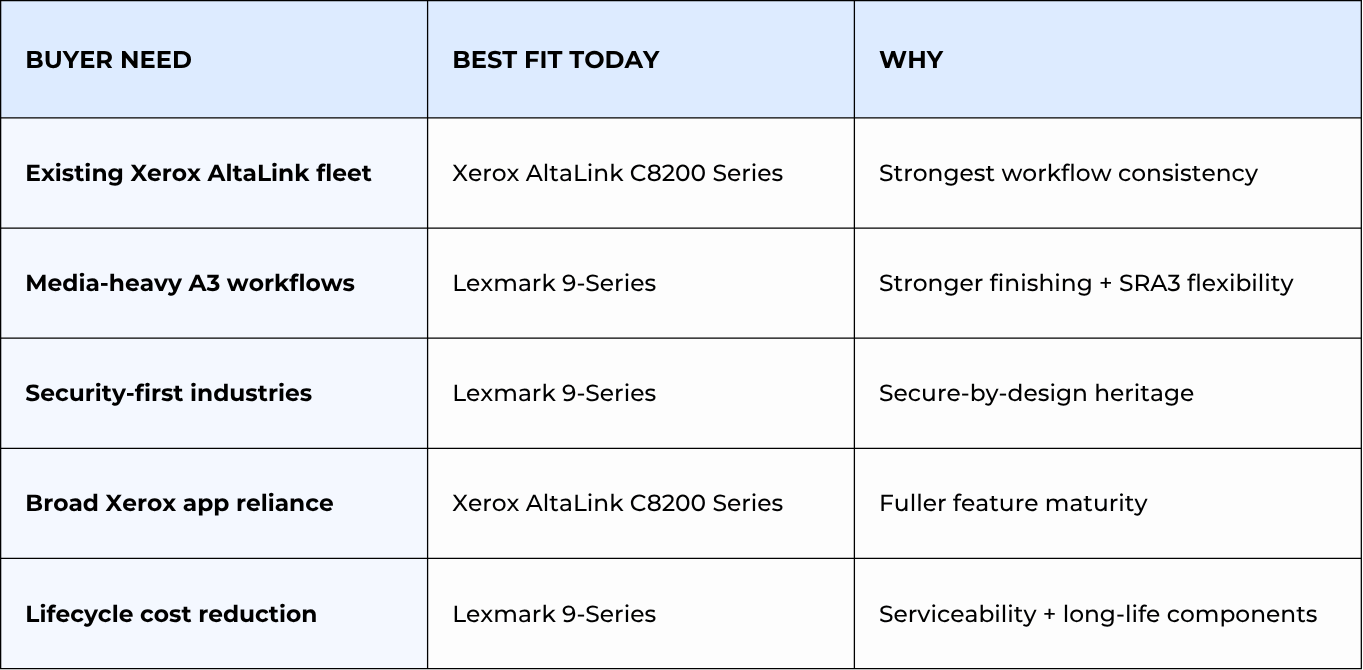
The new Lexmark 9-Series adds more options to the Xerox ecosystem rather than disrupting it.
This is important to keep in mind over the next year as additional A3 9-Series models are set to launch.
Where Lexmark and Xerox Workflows Now Overlap
This is where many buyers are understandably curious.
Yes, select Lexmark 9-Series models now support Xerox workflow tools and apps.
Today, compatible eSF-enabled models can run:
- Xerox Workflow Central
- Select ConnectKey apps
- Xerox Easy Assist
- Print & Scan Experience
- Xerox Workplace Cloud
Lexmark 9-Series supports some parts of the Xerox workflow ecosystem today, but not all.
With future Lexmark releases and firmware updates, they are likely to support additional Xerox workflow behaviors, app compatibility, and back-office support features.
If you're interested in a Lexmark device, check if it fully supports Xerox-native features your team relies on. If not, decide whether you need complete compatibility now or if gradual support is enough for your environment.
Our Vendor Perspective After 40 Years in Print
From a vendor standpoint, this integration creates three major opportunities.
Better fleet right-sizing
Not every customer needs the same A3 platform. Some environments benefit from AltaLink’s deeper Xerox-native experience.
Others will prefer the 9-Series’ serviceability, media flexibility, and lifecycle efficiency.
Better service coverage
At STPT, we can now help customers evaluate, deploy, and service both brands.
This makes it easier for buyers to choose a device that’s based on business fit rather than channel limitations.
Better long-term standardization
This may be the biggest long-term advantage.
A mixed Xerox + Lexmark environment is becoming easier to standardize around:
- Workflows
- Remote service behavior
- App ecosystems
- Print security
- MPS visibility
- Future fleet refreshes
Having this consistency makes it simpler to operate a Xerox-Lexmark mixed fleet.
Should Businesses Buy Now or Wait?
The honest answer depends on how important immediate Xerox feature compatibility is to your environment.
Buy now if:
- You need an A3 refresh this year
- SRA3 and advanced finishing matter
- You want strong security now
- Lifecycle cost and easy serviceability matter
- Workflow Central support on compatible models is enough
- Your current vendor can support both Xerox and Lexmark
Wait if:
- Your team relies on specific Xerox-native workflows not yet available
- Full ConnectKey compatibility is a hard requirement
- You want future 2026 9-Series launches
- You prefer a more mature unified branding roadmap
- You know certain unsupported Xerox features are likely to become available in future Lexmark firmware or releases
Some Xerox-exclusive experiences that are not fully supported today are likely transitional gaps, not permanent product limitations.
For many businesses, waiting 6–12 months could give them:
- Broader feature compatibility
- More A3 launch options
- Stronger Xerox back-office integration
- Expanded workflow behavior consistency
If your team is still early in the decision process, our office printer buyer’s guide can help you compare purchasing routes, print volume, and long-term operating costs before choosing a printer.

FAQ
Is Lexmark now part of Xerox?
Yes. The acquisition is complete, and the integration is now actively affecting product portfolios, workflows, and dealer sales models.
Is the Lexmark 9-Series replacing AltaLink?
No. Today, it complements the AltaLink series by extending Xerox’s A3 coverage into additional media, finishing, and serviceability use cases.
Can Lexmark printers run Xerox Workflow Central?
Yes, certain eSF-enabled 9-Series devices can run Workflow Central and select Xerox apps.
Should I wait for more Xerox features on Lexmark?
If your workflows rely on very specific Xerox-native features, it’s a good idea to wait and see if support is expanded.
What Buyers Should Do Next
If you’ve been evaluating the Lexmark 9-Series vs. Xerox AltaLink, it’s critical to understand which platform best supports your workflows today.
Now that you have a clearer picture of how the integration is changing the A3 market, it’s time to evaluate which devices fit your environment, security needs, workflow requirements, and growth plans.
At STPT, we’ve spent nearly 40 years helping businesses make printer decisions that hold up long after the purchase date.
If you’re wondering whether a Lexmark 9-Series model, a Xerox AltaLink, or a future-ready mixed fleet strategy makes the most sense, contact our team and we’ll help you evaluate the best fit for your environment.
That way, your next printer decision supports not only what your team needs today, but where your business is headed next.
