 Skip to main content

We all know that time is precious, especially in the fast-paced world of business. So, when it comes to finding the perfect multifunction printer for your company, it's all too easy to get bogged down in endless options.
We're here to make things easier by putting two leading brands, Xerox and Konica Minolta, head-to-head. We'll give you the lowdown on both brands, highlighting the differences, similarities, and costs of their products. Our goal is to arm you with all the info you need to make a smart decision.
Just to be clear, we sell Xerox products at Strategic Technology Partners of Texas. But that doesn't mean we're biased. We're all about putting you first, understanding your unique needs, and helping you find the best solution for your business or personal goals. That's our commitment to you, and it's at the heart of everything we do.
Need a printer/copier? Download your free copy of the Complete Guide to Purchasing or Leasing a Printer for Your Business to make sure you get the right machine in place the first time.
Table of Contents
- Short Answer: Xerox vs. Konica Minolta
- Comparison Table: Xerox vs. Konica Minolta
- What Are the Main Differences Between Xerox and Konica Minolta?
- Overview of Xerox
- Overview of Konica Minolta
- Key Differences Between Xerox and Konica Minolta
- What Do Xerox and Konica Minolta Have in Common?
- How Do Xerox and Konica Minolta Compare in Cost?
- Which Printer Brand Is Best for Your Business?
- Compare Xerox to Other Brands
- FAQ
- Quick Summary
Short Answer: Xerox vs. Konica Minolta
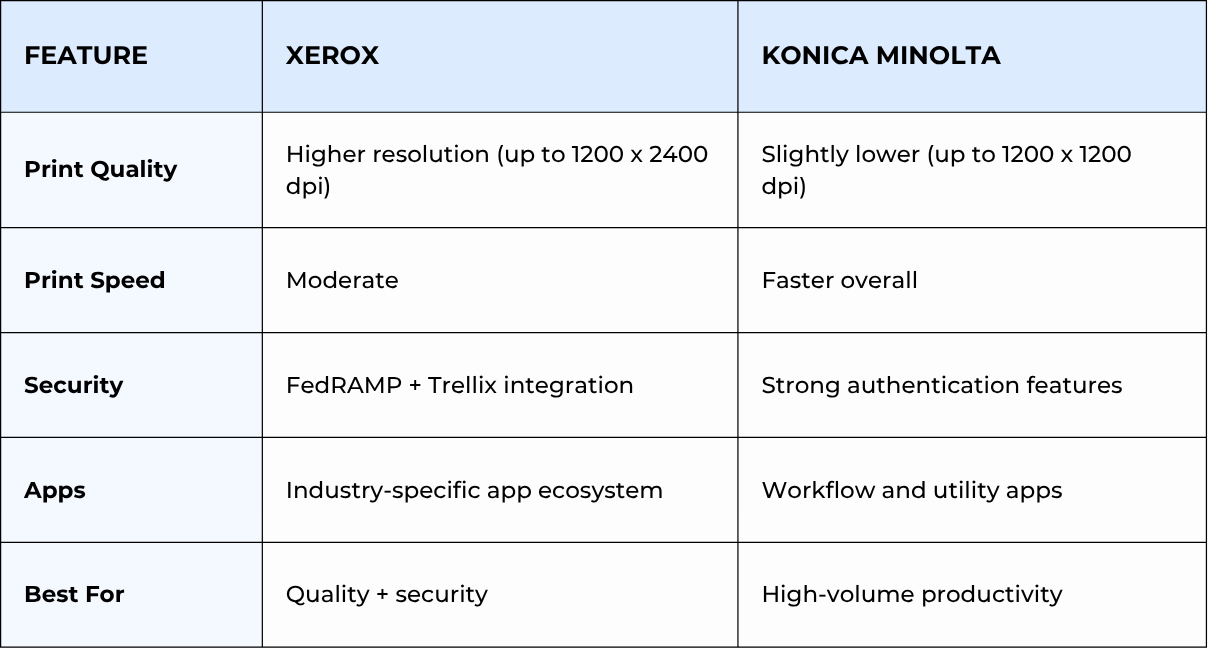
Xerox is better for print quality, security, and advanced app integrations, while Konica Minolta is better for speed, high-volume printing, and cost efficiency. The right choice depends on whether your business prioritizes output quality or production speed.
Comparison Table: Xerox vs. Konica Minolta
What Are the Main Differences Between Xerox and Konica Minolta?
The main differences between Xerox and Konica Minolta come down to user interface, app ecosystem, and security features. Xerox focuses on advanced integrations and security, while Konica Minolta emphasizes speed, usability, and efficiency for high-volume environments.
Overview of Xerox
Xerox was founded in 1906 and pioneered xerographic printing technology. Today, Xerox operates in over 160 countries and holds more than 13,000 active patents for innovation.
Xerox printers support both office and production environments, seamlessly integrating with cloud and mobile workflows while emphasizing security and automation.
Xerox printers deliver high-resolution output for businesses that prioritize quality.
Overview of Konica Minolta
Konica Minolta is a Japanese multinational corporation formed in 2003 through a merger and headquartered in Tokyo, Japan. The company focuses on digital, optical, and business technology.
In 2004, Konica Minolta introduced its first Bizhub multifunction printer, which supports high-volume offices. Konica Minolta’s catalogue features printers that prioritize speed, efficiency, and integration with workflow tools.
Konica Minolta printers support fast, high-volume business printing environments.
Key Differences Between Xerox and Konica Minolta
User Interface and Experience
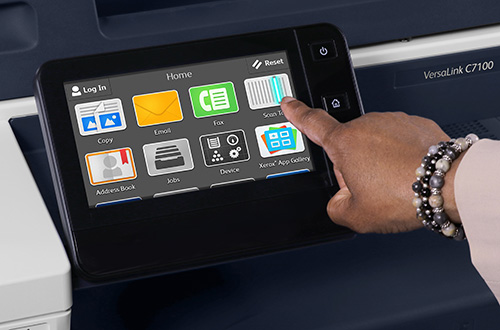
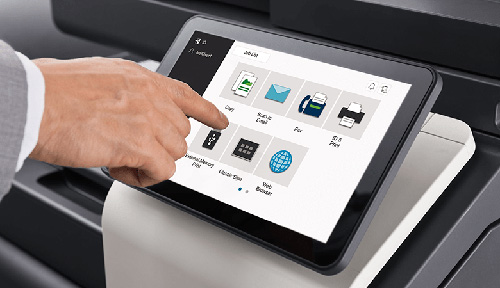
Xerox offers a more app-driven, customizable interface, while Konica Minolta focuses on usability and workflow efficiency.
Xerox AltaLink and VersaLink multifunction printers (MFPs) feature ConnectKey technology. This platform gives users multiple benefits, including:
- Tablet-like interface
- Mobile and cloud connectivity
- Benchmark security
- Custom applications
ConnectKey technology provides a familiar, intuitive touchscreen interface and allows users to download apps to improve office productivity.
Xerox ConnectKey technology also improves security through firmware validations upon start-up.
Konica Minolta's Bizhub MFPs feature a customizable multi-touch panel that enables remote access and cloud integration to platforms such as Google Drive and Gmail. You can access Bizhub devices remotely using NFC and mobile connectivity.
Some of the other features on Konica Minolta’s MFPs include:
- IC card authentication
- Top-class power consumption
- Industry-standard mobile connectivity
- USB interface for external keyboard, Bluetooth printing, and voice guidance support
Xerox's User Interface
Konica Minolta's User Interface
2. App Ecosystem
Xerox provides more industry-specific applications, while Konica Minolta focuses on workflow tools and utilities.
The Xerox App Gallery features apps that support industries such as business, healthcare, and education. Xerox apps automate workflows like scanning and approvals.
Examples of Xerox apps include:
- Xerox Connect for Microsoft 365: Makes file digitization easier by letting users print from and scan to a Microsoft 365 account.
- Xerox Scan to Cloud Email: Provides a simple and secure way to scan hardcopy documents and send them to one or multiple recipients within minutes.
Check out our blog for the top 5 printer productivity apps available in the Xerox App Gallery.
Konica Minolta has the Konica Minolta Marketplace, which offers various applications for enterprise content management, MFP panel customization, and internal communication.
Examples of Konica Minolta’s applications:
- Announcement App: Lets users display announcements as a screensaver on the MFP control panel, effectively relaying messages to team members.
- How2: Offers easy-to-follow PDF tutorials to help users learn to perform common MFP operations.
Want to explore printer apps further? Read our blog on the pros and cons of printer apps.
Printer Security
Xerox leads in advanced security certifications, while Konica Minolta offers strong user authentication features.
In 2018, Xerox became the first MPS vendor to receive security authorization from the Federal Risk and Authorization Management Program (FedRAMP). This means Xerox’s security measures meet the United States government’s standard for cloud service offerings. Learn about Xerox’s approach to printer security here.
Konica Minolta’s MFPs have the IC card authentication feature. This feature helps prevent unauthorized use by validating ID cards with card readers, ensuring the user has proper access to the machine.
While both models offer robust security, Xerox’s partnership with McAfee/Trellix gives its product line an edge, particularly through its whitelisting feature.
As cybercrime continues to rise, it's important to understand your device's security features and the steps companies are taking to prevent cyberattacks. This helps in deciding which company to trust.
What Do Xerox and Konica Minolta Have in Common?
Both brands offer similar core capabilities:
Multiple Printing Options
Say you’re looking for a printer to do, well, just that, print: Both brands offer single-function printers if you’re not in the market for an all-in-one or multifunction printer. They also have an array of scanner options.
Both Xerox and Konica Minolta also support production-level printing with options to scale across business sizes.
Not sure if you need a production printer? Read: Is a Production Printer Right for Your Business?
Environmental Certifications
Both Xerox and Konica Minolta’s devices meet EPEAT (Electronic Product Environmental Assessment Tool) standards. EPEAT is a global eco-label for the IT sector that ensures manufacturers are environmentally conscious when buying and selling electronic products.
Both brands support sustainable printing practices
How Do Xerox and Konica Minolta Compare in Cost?
Konica Minolta devices are often more cost-efficient upfront, while Xerox devices deliver higher output quality and long-term value.
To determine the best deal between Xerox and Konica Minolta, compare similar models from both brands to evaluate their features, capabilities, and pricing differences.
Example Comparison:
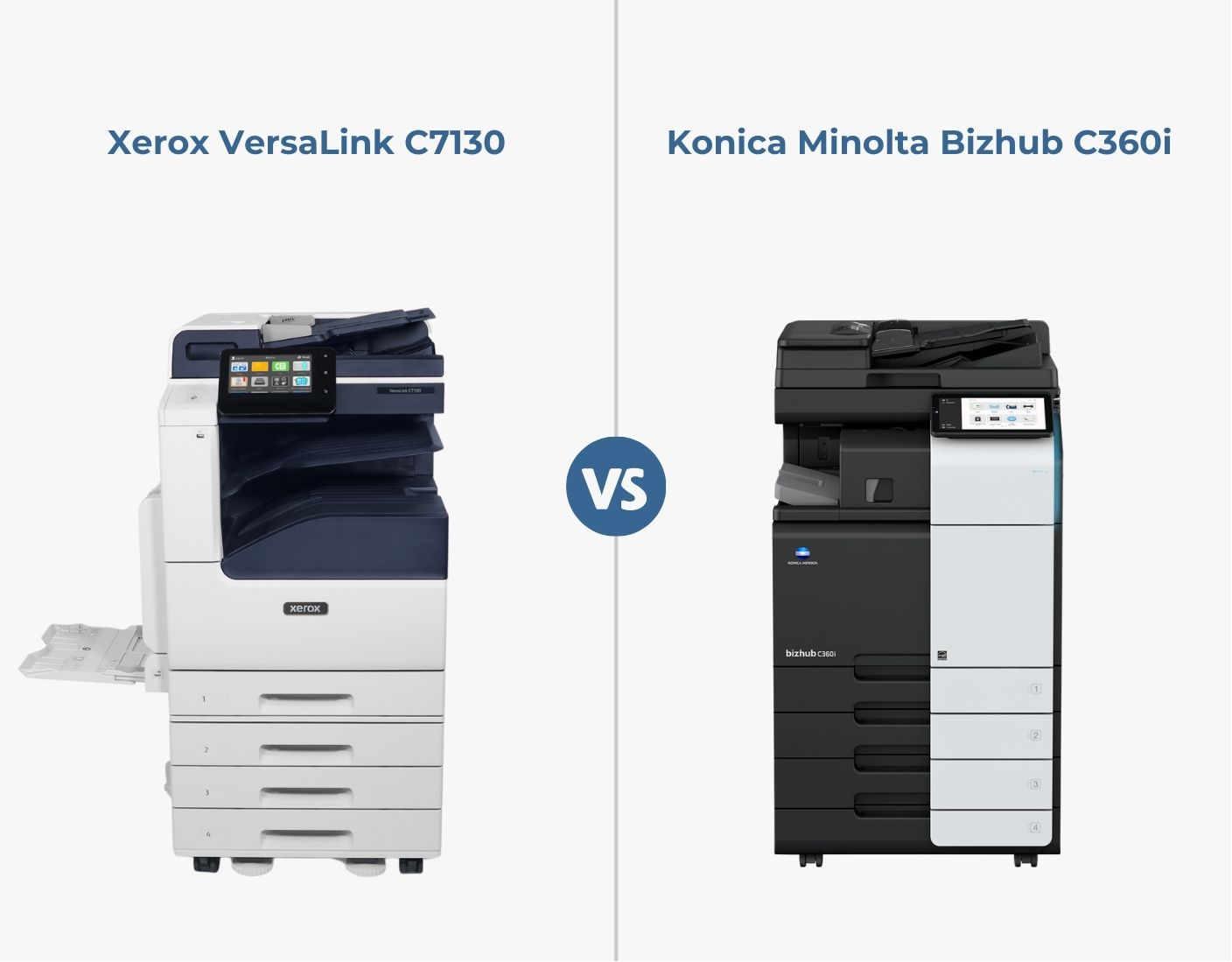
- Xerox VersaLink C7130 ≈ $7,000
- Konica Minolta Bizhub C360i ≈ $4,000
Key Differences Between Models:
Both models are designed for mid-to-large workgroups, but they differ in speed, volume, and print quality.
- Print Speed: Konica Minolta Bizhub C360i prints faster (36 ppm) than the Xerox VersaLink C7130 (30 ppm).
- Monthly Volume: Konica Minolta Bizhub C360i supports higher output (up to 33,000 pages/month), while the Xerox VersaLink C7130 is better for moderate use (up to 7,000 pages/month).
- Print Quality: Xerox VersaLink C7130 has higher resolution (1200 x 2400 dpi) for sharper prints, while the Konica Minolta Bizhub C360i offers solid but lower resolution (1200 x 1200 dpi).
Both the Xerox VersaLink C7130 and the Konica Minolta bizhub C360i machines are strong performers. The right choice comes down to whether your workflow values speed and volume or precision and output quality.
By understanding your specific printing needs and comparing models, you can make a more informed decision on what printer has the best cost.
To further help you make a smart printer purchase, check out these articles:
- How Much Does a Printer Cost?
- Top Six Things to Consider When Buying a Printer
- 3 Tips for Saving Money on Your Next Printer/Copier
Which Printer Brand Is Best for Your Business?
Xerox is best for businesses that need high-quality output, strong security, advanced app integrations, or production-level printing. Konica Minolta is best for businesses that need fast, high-volume printing at a lower upfront cost.
The right choice depends on factors like:
- Your monthly print volume
- Your need for print quality
- Your workflow and security requirements
If you're unsure, we can help you evaluate your environment and recommend the best fit, even if it’s not Xerox.

Compare Xerox to Other Brands
If you’re still exploring options, check out these comparisons:
- Xerox vs. HP
- Xerox vs. Brother
- Xerox vs. Canon
- Xerox vs. Ricoh
- Xerox vs. Toshiba
- Xerox vs. Kyocera
- Xerox vs. Lexmark
- Xerox vs. Fujitsu
FAQ
Which is better, Xerox or Konica Minolta?
Xerox is better for print quality and security, while Konica Minolta is better for speed and high-volume printing. The best choice depends on your business needs.
Which printer brand has better print quality?
Xerox printers typically offer higher print resolution, making them better for graphics, marketing materials, and detailed documents.
Which printer is better for high-volume printing?
Konica Minolta printers are generally better suited for high-volume environments due to faster speeds and higher monthly duty cycles. However, it largely depends on the model you choose.
Are Xerox printers more secure than Konica Minolta?
Xerox printers offer advanced security features, including FedRAMP compliance and Trellix integration, giving them an edge in security.
Which copier brand is best overall?
There is no single “best” brand. The best copier depends on your business size, print volume, and workflow needs.
Quick Summary: Xerox vs. Konica Minolta
- Choose Xerox for higher print quality and stronger security
- Choose Konica Minolta for faster speeds and higher volume
- Xerox offers a more advanced app ecosystem
- Konica Minolta provides better efficiency for busy offices
- Comparing models instead of brands leads to better decisions
Find the Right Printer for Your Business
Choosing between Xerox and Konica Minolta comes down to what your business needs most. Whether that be print quality, speed, or long-term efficiency. Once you understand your print volume, workflow, and priorities, the decision becomes much easier.
If you’re still weighing your options, the next best step is to see how these factors apply to your specific situation.
Our Complete Guide to Purchasing or Leasing a Printer for Your Business explains the differences between leasing and buying, where to purchase a printer, and the actual costs of ownership, among other topics.
If you already know what you need, use our Product Configurator to explore suitable models or consult one of our print experts for personalized recommendations.
